

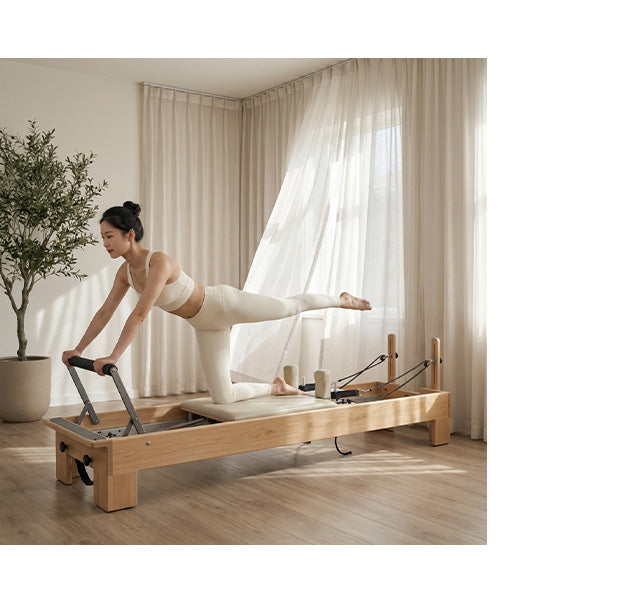
You finally brought home a Pilates reformer (or you’re looking at that studio machine wondering where to start). The carriage is slick, the springs look intimidating, and suddenly you're asking: What do I actually do first?
Having a visual Pilates Reformer exercises chart posted near your machine transforms your workout from hesitant pauses into a smooth, seamless flow. Whether you want to tone your core, improve posture, or master spring tension settings, this breakdown will serve as your ultimate cheat sheet.
How to Read a Pilates Reformer Workout Chart
Before jumping into the moves, you need to understand the three universal variables on any Reformer chart:
1、Spring Tension: Most standard Reformers use a color-coded system (Red = Heavy, Blue = Medium, Yellow = Light).
2、Footbar & Straps Position: Dictates your leverage and stability.
3、Primary Focus: Target muscle groups (e.g., powerhouse/core, posterior chain, upper body stability).
Pro-Tip from the Studio: Heavy tension isn't always "harder." Heavy springs support you during leg work, but light springs challenge your core stability tenfold during arm work or Long Stretch.
The Essential Pilates Reformer Exercise Chart Matrix
Here is the quick-reference exercise breakdown every reformer enthusiast should bookmark.
| Exercise Name | Muscle Focus | Recommended Springs | Level | Form Priority |
| Footwork (Toes, Arches, Heels) | Quads, Glutes, Calves, Core | 3–4 Heavy (Red/Blue) | Beginner | Keep pelvis neutral; don't bounce off the footbar. |
| The Hundred | Deep Core, Breath Control | 2 Medium (Red/Blue) | Beginner | Anchor low back; pump arms with energy from the armpits. |
| Midback Series (Arm Circles) | Lats, Shoulders, Triceps | 1 Medium or 1 Light | Beginner | Keep carriage completely still while moving arms. |
| Elephant | Hamstrings, Spine Flexion, Abdominals | 1 Heavy or 2 Medium | Intermediate | Press through heels; lift abdominals up and away from carriage. |
| Scooter | Gluteus Maximus, Balance, Leg Strength | 1 Heavy | Beginner / Inter. | Keep standing knee bent over ankle; stabilize hips. |
| Short Box: Flat Back | Erector Spinae, Transverse Abdominis | All Springs (Carriage Locked) | All Levels | Hinge from the hips with a long spine; keep feet hooked in strap. |
| Long Stretch (Plank) | Shoulder Girdle, Full Core, Quadriceps | 2 Medium | Intermediate | Keep body in a strong plank; push carriage back with shoulders. |
5 Must-Have Movements for Every Reformer Routine
If you’re building your daily routine from your chart, ensure these five baseline exercises are always included:
1. Footwork (The Universal Warm-Up)
-
Why it matters: Wakes up the lower body alignment, activates foot arches, and sets up your breath rhythm.
-
Cueing: Press through the footbar smoothly. Keep your collarbones wide and shoulders rested against the shoulder blocks without tension.

2. Feet in Straps (Leg Circles & Frog)
-
Why it matters: The ultimate crowd-pleaser for hip mobility, hamstring lengthening, and lower abdominal engagement.
-
Cueing: Only lower your legs as far as you can maintain a neutral spine. Do not let your lower back arch off the carriage.
3. The Elephant
-
Why it matters: Decompresses the lumbar spine while firing up the hamstrings and lower abs.
-
Cueing: Imagine a hoist underneath your navel lifting you up toward the ceiling. Your feet press down, but your abs drive the carriage return.
4. Short Box Series
-
Why it matters: Builds rotational strength and spinal articulation that directly translates to better everyday posture.
-
Cueing: Sit tall on the box. Before leaning back, pull your abdominal wall inward and up.
5. Mermaid
-
Why it matters: Opens up lateral side-bodies and intercostal muscles, improving breathing capacity and ribcage mobility.
-
Cueing: Keep both sit bones grounded as you reach up and over—think length before height.

3 Common Mistakes When Following a Reformer Chart
-
Rushing the Transitions: The space between exercises is where you build genuine control. Don't snap the springs back; resist the carriage on the return phase (eccentric control).
-
Using the Wrong Spring Tension for Your Body: Charts provide standard guidelines, but if your lower back aches during leg work, add a spring. If your shoulders hike during arm work, drop a spring.
-
Holding Your Breath: Inhale through the nose to prepare; exhale through the mouth on the point of exertion.
Ready to Elevate Your Home Practice?
Mastering the Reformer isn't about doing the most complicated trick—it’s about precision, control, and consistency.
Looking for premium, studio-grade Pilates equipment and non-slip accessories? Explore our Reformer Collection today and get free shipping on your first order.

