


If you run a fitness brand, a boutique studio, or a wellness e-commerce store, you have almost certainly fielded this question from prospective clients: can Pilates build muscle?
The short answer is yes — but with important caveats. Pilates can absolutely build lean, functional muscle and increasing research confirms measurable gains in strength and body composition. However, how much muscle you build, and where Pilates fits relative to traditional weight training, depends on the modality (mat vs. Reformer Pilates), programming, and progressive overload.
This guide breaks down what the current evidence says, where Pilates vs weight training diverge, and how to position Pilates as a muscle-building tool for your audience.
Key takeaway: Pilates is not a replacement for heavy resistance training if the goal is maximum hypertrophy. But for building a strong, defined, injury-resistant physique — the so-called Pilates body — it is one of the most effective and accessible methods available.

What Does "Building Muscle" Actually Mean?
Before answering can Pilates build muscle, it helps to define the mechanism. Muscle growth (hypertrophy) is driven by three primary stimuli:
|
Stimulus |
How it works |
Pilates relevance |
|
Mechanical tension |
Lifting against resistance near muscular failure |
High in Reformer work with springs |
|
Metabolic stress |
Sustained time-under-tension, burn, pump |
Very high in Pilates (slow, controlled reps) |
|
Muscle damage |
Eccentric loading and novel movement |
Moderate; high for beginners |
Pilates trains all three — particularly mechanical tension (via spring resistance on the Reformer) and metabolic stress (via slow, controlled, high-rep sets). That is precisely why the practice produces visible, measurable change.
Does Pilates Build Muscle Mass? What the Research Says
Recent peer-reviewed studies give a clear, encouraging picture for Pilates for muscle growth.
Reformer Pilates and Body Composition
A 2025 study published in Scientific Reports (Nature) examined the effects of Reformer Pilates on body composition, strength, and endurance in overweight and obese women. The training program delivered improvements in muscular endurance and strength markers, supporting the role of spring-based Pilates as a legitimate resistance modality — not just a "gentle stretch."
Pilates vs Resistance Training
Head-to-head comparisons consistently show:
- Pilates excels at improving core strength, flexibility, posture, and muscular endurance.
- Resistance training (traditional lifting) produces larger gains in maximal strength and absolute muscle mass.
- Both improve body composition and functional fitness.
In other words, Pilates vs weight training is not an either/or for most clients. They are complementary.
The "Pilates Body" Is Real
The lean, elongated look associated with the Pilates body comes from a combination of:
- Increased lean muscle tissue (especially deep stabilizers)
- Reduced body fat through consistent movement
- Improved posture that makes the physique appear taller and more defined
So when someone asks does Pilates build muscle mass, the honest answer is: it builds lean, functional mass — often without the bulk that some clients actively want to avoid.
Mat Pilates vs Reformer Pilates for Muscle
Not all Pilates is created equal when the goal is hypertrophy.
|
Modality |
Resistance source |
Muscle-building potential |
Best for |
|
Mat Pilates |
Bodyweight + gravity |
Moderate (beginners/new movers) |
Accessibility, core foundation |
|
Reformer Pilates |
Adjustable spring tension |
High |
Progressive overload, lean muscle |
|
Cadillac / Tower |
Springs + straps |
High |
Targeted strengthening |
|
Chair / Barrel |
Springs + leverage |
High |
Glutes, legs, posterior chain |
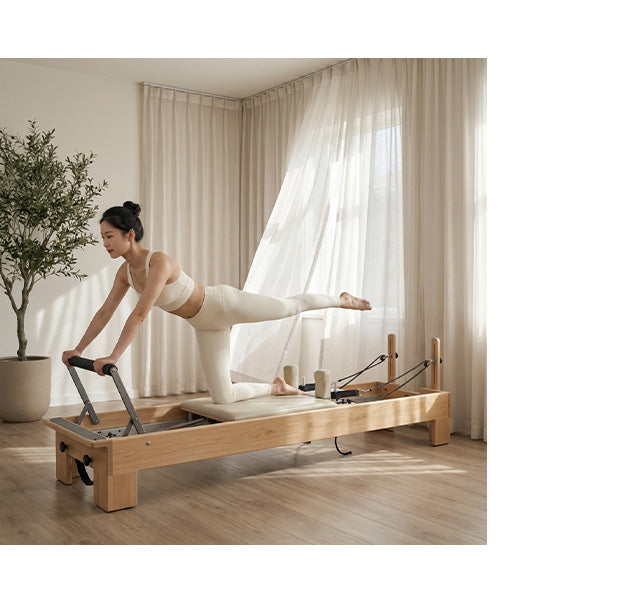
If you are recommending the best Pilates equipment for muscle, the Reformer is the clear flagship. Its variable spring resistance lets instructors apply the progressive overload principle — the single most important driver of long-term muscle adaptation.
How to Build Muscle with Pilates: 5 Programming Principles
For operators and coaches, here is how to turn Pilates into a genuine muscle-building protocol:
- Apply progressive overload. Increase spring tension, reps, or tempo every 2–4 weeks.
- Train close to failure. Controlled, high-quality reps taken near fatigue stimulate hypertrophy.
- Prioritize compound, loaded patterns. Squats, lunges, pull-downs, and plank variations on the Reformer.
- Control tempo. Slow eccentric phases (3–4 seconds) maximize metabolic stress.
- Be consistent. 3+ sessions per week outperforms sporadic intense bouts.
Pro tip for studios: Clients who track tangible progress (spring settings, reps, measurements) are more likely to retain. Build a simple progress log into your onboarding.
Pilates Body vs Gym Body: Setting the Right Expectation
A frequent objection from prospects is "I want real muscle, not just toning." This is where the Pilates body vs gym body conversation matters.
- The gym body typically reflects maximal hypertrophy from heavy loads.

- The Pilates body reflects balanced, lean, functional muscle with strong deep stabilizers.

Many of your highest-value clients want the second — they fear bulk, prioritize posture and longevity, and are willing to pay a premium for expert-led, low-injury-risk training. That is a B2B and B2C positioning opportunity worth owning.
Where Pilates Falls Short (and How to Fill the Gap)
To maintain trust (and EEAT), be transparent about limitations:
- Absolute strength ceiling is lower than heavy lifting.
- Large muscle groups (e.g., quads, lats) may need external load beyond spring resistance for advanced clients.
- Hypertrophy speed is generally slower than progressive barbell training.
Solution: Hybrid programming. Pair Pilates with minimal resistance training, or offer small-group Reformer classes with added dumbbells/bands for clients chasing more mass.
FAQ
Q:Can Pilates build muscle or just tone?
Pilates builds real lean muscle, especially on the Reformer. "Toning" is simply mild hypertrophy plus reduced body fat — which Pilates delivers.
Q:How long does it take to build muscle with Pilates?
Most clients notice strength and definition in 6–8 weeks, with visible lean-mass changes by 12 weeks of consistent training (3+ sessions/week).
Q:Is Reformer Pilates better than mat for muscle?
Yes. The adjustable spring resistance enables progressive overload, making Reformer Pilates the superior muscle-building modality.
Q:Can Pilates replace weight training for muscle growth?
For maximum size, no. For lean, functional muscle and injury-resistant strength, Pilates is highly effective and can stand alone for many clients.
Q:Does Pilates build muscle mass for men?
Yes. While often marketed to women, the mechanisms (tension, time-under-tension, overload) work identically for all sexes.
Final
Whether helping students break through muscle-building plateaus or creating high-retention, premium courses for the studio, the effectiveness of Pilates for muscle building ultimately depends heavily on the quality of the equipment.
The core of Pilates muscle building lies in "progressive overload" and "precise tension control." If the spring resistance of the equipment decays quickly, the slide rails are not smooth enough, or the structure lacks stability, it will not only cause muscles to lose continuous and smooth mechanical tension, but may also pose safety hazards when students attempt high-intensity movements. High-quality professional equipment is the cornerstone of scientific muscle building and the ultimate exercise experience. Want to provide your clients with a truly "successful" Pilates experience? Come to Mowin and choose the most suitable professional Pilates equipment to start a new chapter of high-quality muscle building!