




A product sample can look perfect on a supplier's desk and still cause problems once thousands of units reach your warehouse.
For Pilates brands, retailers, studios, distributors, and private-label buyers, sample approval is more than checking whether a product “looks right.” The approved sample often becomes the reference point for the entire production run.
That makes the sampling stage one of the most important quality-control steps in the purchasing process.
A Pilates ring may have the correct diameter but feel too flexible. A resistance band may have the right color but fail to deliver consistent resistance. A Pilates ball may look fine in photos but have an unpleasant surface finish or inconsistent inflation. Even packaging and logo placement can change between the approved sample and mass production if they were never clearly confirmed.
For buyers, the goal is simple:Don't approve a sample until you know exactly what you are approving.
Here is a practical checklist to use before signing off on a Pilates product sample.
1. Start With the Original Product Specification
Before touching the sample, compare it against the specifications agreed with the supplier.
This sounds obvious, but it is one of the easiest steps to overlook when the sample looks visually impressive.
Create a simple specification sheet covering:
-
Product name and model
-
Material
-
Dimensions
-
Weight
-
Thickness
-
Color
-
Resistance level, where applicable
-
Logo and branding requirements
-
Accessories included
-
Packaging requirements
-
Labeling requirements
-
Intended use
-
Any agreed testing or compliance requirements
For example, if you are sourcing a Pilates ring, don't simply record “38 cm Pilates ring.”
Your specification should be closer to:
- Diameter: 38 cm
- Material: [approved material]
- Weight: [approved weight]
- Color: [approved color reference]
- Logo: [position + size + method]

The more precisely the product is documented, the less room there is for interpretation during mass production.
2. Check the Material — Not Just the Material Name
A supplier stating that a product is made from TPE, NBR, EVA, PP, natural rubber, silicone, polyester, or another material does not tell you everything about how the finished product will perform.
Two products can use the same general material but feel very different because of differences in formulation, density, hardness, construction, or processing.
What should buyers check?
Depending on the product, evaluate:
-
Surface texture
-
Hardness or softness
-
Flexibility
-
Elasticity
-
Density
-
Grip
-
Odor
-
Recovery after deformation
-
Surface consistency
-
Color consistency
-
Edge finishing
For products that come into frequent contact with skin, also pay attention to the feel of the material during actual use.
A Pilates accessory shouldn't be evaluated only on a table. Use it the way your customer will use it.
That distinction matters.
3. Measure the Sample Yourself
Never rely entirely on the supplier's stated dimensions.
For every important dimension, measure the physical sample and record the result.
Depending on the product, this may include:
| Product | Measurements to Check |
|---|---|
| Pilates Ring | Diameter, thickness, handle dimensions |
| Pilates Ball | Diameter, inflated size |
| Resistance Band | Length, width, thickness |
| Ankle/Wrist Weights | Dimensions, weight |
| Pilates Weights | Diameter, thickness, weight |
| Yoga/Pilates Mat | Length, width, thickness, weight |
| Massage Ball | Diameter, height, surface dimensions |
You don't necessarily need laboratory equipment for every product.
A ruler, digital scale, caliper and appropriate measuring tools can already identify many discrepancies.
More importantly, record the actual approved measurement rather than relying on memory.
This becomes useful later when the production batch arrives.
4. Don't Ignore Weight
Weight is often treated as a minor specification, but for fitness products it can directly affect the user experience.
Consider a Pilates weight.
If the target weight is 1 kg but production gradually moves toward 900 g or 1.1 kg, the difference may affect how the product feels during training.
The same principle applies to:
-
Wrist weights
-
Ankle weights
-
Pilates dumbbells
-
Massage balls
-
Pilates rings
-
Weighted accessories
Use a digital scale to verify the sample.
If the product is sold in sets, weigh the complete set, not only one individual component.
Also clarify whether the supplier's stated weight includes:
-
Product only
-
Accessories
-
Packaging
-
Individual box
-
Full retail set
This avoids surprisingly different numbers later.
5. Test the Product in Real Use
This is where many sample approvals become too superficial.
A product can pass a visual inspection and still fail during actual use.
Before approval, perform several realistic exercises or movements.
For example:
Pilates Ring
Check:
-
Compression feel
-
Resistance
-
Recovery
-
Handle comfort
-
Stability
-
Frame deformation
-
Noise during use

Resistance Band
Check:
-
Stretching feel
-
Resistance consistency
-
Recovery
-
Surface grip
-
Seams or edges
-
Connection points
-
Behavior after repeated stretching
Pilates Ball
Check:
-
Inflation stability
-
Surface grip
-
Shape
-
Compression
-
Air retention
-
Valve performance
Ankle or Wrist Weights
Check:
-
Fit
-
Closure strength
-
Weight distribution
-
Edge comfort
-
Movement stability
-
Whether the product shifts during exercise
The question isn't simply:“Does the product work?”
Ask instead:“Would I be comfortable selling this product under my own brand?”
That is a much higher standard.
6. Pay Special Attention to Moving, Stretching and Load-Bearing Parts
Some Pilates products experience repeated mechanical stress.
These areas deserve more attention than decorative surfaces.
Look closely at:
-
Seams
-
Stitching
-
Handles
-
Buckles
-
Straps
-
Valves
-
Connections
-
Welded areas
-
Adhesive joints
-
Elastic components
-
Metal/plastic interfaces
Try the product repeatedly rather than performing one quick test.
For example, if you are evaluating a resistance band, don't stretch it once and decide that it is acceptable.
Repeated-use products should be assessed with repeated-use conditions in mind.
For higher-risk or mechanically loaded products, buyers should also discuss appropriate product-specific testing with their supplier or an independent testing laboratory.
7. Check Color Under Consistent Lighting
Color discrepancies are surprisingly common in private-label production.
A sample may look correct under one light source and noticeably different under another.
For branded products, don't approve color based solely on:
-
A phone screen
-
A product photo
-
A screenshot
-
A supplier's description such as “dusty pink” or “sage green”
Instead, establish a clear reference.
This can be:
-
A physical color standard
-
A recognized color reference
-
An approved physical sample
-
A defined digital color specification where appropriate
Then record the approved reference in the purchase documentation.
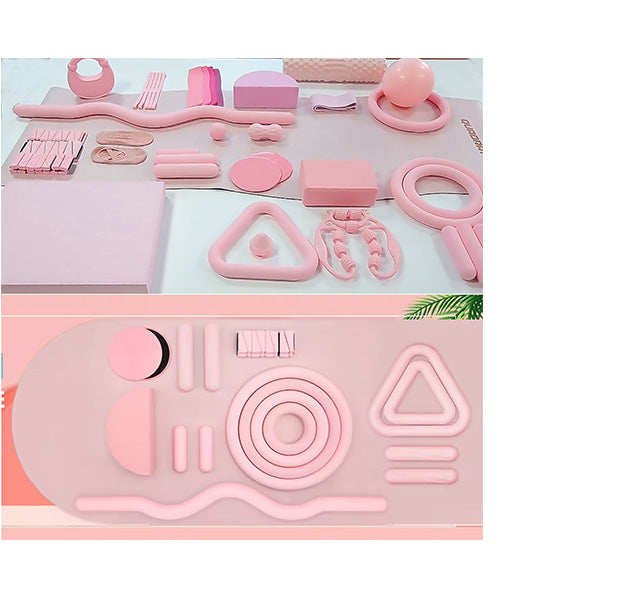
This is especially important if you are ordering a complete Pilates collection where rings, balls, resistance bands, weights and other accessories are expected to appear as one coordinated color system.
8. Inspect Logo and Branding Details
For private-label products, the logo isn't an optional decoration.
It is part of the product specification.
Check:
-
Logo size
-
Position
-
Orientation
-
Printing method
-
Embossing/debossing
-
Color
-
Sharpness
-
Adhesion
-
Surface finish
Also inspect the logo after normal use.
For example:
-
Does printing rub off?
-
Does heat affect it?
-
Does stretching distort it?
-
Does cleaning affect the surface?
-
Does the logo crack when a flexible product is repeatedly bent?
A logo that looks excellent on a new sample but deteriorates quickly can become a brand-quality problem.
9. Inspect the Packaging Separately
A good product inside poor packaging can still create problems.
For wholesale buyers, packaging should be checked as carefully as the product itself.
Review:
Retail packaging
-
Box dimensions
-
Material
-
Printing quality
-
Logo
-
Product information
-
Barcode
-
Warning information
-
User instructions
Inner packaging
-
Protection
-
Plastic bags or sleeves
-
Product positioning
-
Moisture protection where necessary
Shipping packaging
-
Carton dimensions
-
Carton strength
-
Number of units per carton
-
Gross weight
-
Net weight
-
Carton markings
Don't approve packaging simply because it looks attractive.
Ask whether it can realistically protect the product during international transportation.

10. Confirm Product Information and Safety Requirements
This step becomes increasingly important when products are sold internationally.
The applicable requirements depend on the product, market, materials, intended use and sales channel. Buyers should identify the relevant requirements before final approval rather than discovering them after production.
For example, EU product rules can involve requirements relating to product characteristics, composition, packaging, instructions, labeling and traceability. The EU's current General Product Safety Regulation also requires businesses covered by it to address product safety, risk assessment, technical documentation and product identification.
For products intended for the EU market, don't simply ask a supplier:“Is this product CE certified?”
That question may not even be appropriate for the particular product.
Instead, ask:What regulations and standards apply to this specific product and intended market?
Then determine which documentation, testing or labeling is actually required.
This is a much safer approach than collecting certificates simply because another supplier has them.
11. Compare the Sample With Your Customer's Actual Positioning
A sample should be evaluated against your market positioning, not only the supplier's catalog.
Imagine two buyers sourcing the same Pilates ring.
One is selling through a budget marketplace.
The other is building a premium Pilates brand.
Their acceptable standards may be completely different.
Ask:
-
Is the material consistent with our price positioning?
-
Does the product feel premium enough?
-
Is the packaging appropriate?
-
Is the branding clean?
-
Does the product photograph well?
-
Is the product comfortable during use?
-
Does it match the rest of our product range?
-
Would customers understand the product's value from the physical product alone?
Sample approval should answer both:“Is this technically acceptable?” and “Is this commercially right for our brand?”
12. Test the Sample More Than Once
A single inspection gives you a snapshot.
Repeated use tells you much more.
For products designed for repeated exercise, consider establishing a simple internal testing routine before approval.
For example:
Initial inspection → functional use → repeated-use test → cleaning → second inspection → final decision
After testing, look for:
-
Surface changes
-
Deformation
-
Cracking
-
Color changes
-
Loose stitching
-
Loss of elasticity
-
Changes in resistance
-
Odor
-
Loose components
-
Printing damage
The exact testing method should depend on the product and its intended use. Don't invent a universal “number of repetitions” and treat it as an industry standard.
13. Keep the Approved Sample as the Golden Sample
Once the sample is approved, don't simply send an email saying:“Sample approved.” That is too vague. Instead, create an approved sample record.
It should contain:
-
Product photos
-
Actual dimensions
-
Actual weight
-
Material specification
-
Color reference
-
Logo artwork
-
Logo dimensions and position
-
Packaging specifications
-
Accessories
-
Test requirements
-
Approved modifications
-
Date of approval
-
Sample version
If possible, keep the physical approved sample.
This becomes your golden sample or reference sample.
When production begins, the finished goods can be compared against this reference.
This is particularly valuable when you work with multiple product models or reorder the same item months later.
14. Separate “Must Match” From “Nice to Have”
Not every specification has the same importance.
A useful approach is to divide requirements into three categories.
Critical
A deviation means the product should not be approved.
Examples:
-
Incorrect material
-
Incorrect product size
-
Incorrect resistance level
-
Structural safety issue
-
Incorrect weight where weight is a key product specification
-
Missing required labeling
-
Major functional failure
Major
A deviation requires correction before production.
Examples:
-
Incorrect logo placement
-
Significant color difference
-
Poor stitching
-
Packaging damage risk
-
Uncomfortable handle
-
Inconsistent surface finish
Minor
A deviation may be acceptable within an agreed tolerance.
Examples:
-
Small cosmetic variation
-
Minor color variation within the agreed reference
-
Small packaging printing imperfection
The important point is that tolerances should be agreed before mass production, rather than negotiated after the goods have been produced.
15. Don't Assume the Approved Sample Guarantees Mass-Production Quality
This is one of the most important points for buyers.
Sample approval and production quality control are two different stages.
The sample demonstrates what the supplier can produce and gives both sides a reference.
It does not automatically prove that every unit in a production batch will be identical.
For larger orders, buyers should consider a production inspection process appropriate to the product and order size.
Sampling-based inspection can be structured using recognized approaches. For example, ISO 2859-1:2026 defines acceptance sampling schemes for lot-by-lot inspection based on AQL and provides methods for determining sample sizes and acceptance criteria.
In practical terms, the process can look like:
Prototype → Sample approval → Pre-production confirmation → Mass production → Inspection → Shipment
This creates several opportunities to catch problems before the products reach your customers.
A Practical Pilates Sample Approval Checklist
Before approving a sample, buyers can work through this checklist:
Product specification
☐ Material confirmed
☐ Dimensions measured
☐ Weight measured
☐ Color approved
☐ Product construction checked
☐ Accessories confirmed
Function
☐ Product performs as intended
☐ Resistance/strength verified where applicable
☐ Moving parts operate correctly
☐ Product remains stable during use
☐ Comfort checked during actual exercise
Appearance
☐ Surface finish acceptable
☐ No obvious defects
☐ Seams and edges clean
☐ Color consistent
☐ Logo correct
☐ Logo position correct
Packaging
☐ Retail packaging approved
☐ Inner packaging approved
☐ Shipping carton checked
☐ Product protection adequate
☐ Carton markings confirmed
Compliance & documentation
☐ Applicable market requirements identified
☐ Required testing discussed
☐ Labels checked
☐ Instructions checked
☐ Traceability information confirmed where required
Production control
☐ Final sample documented
☐ Approved sample retained
☐ Key specifications recorded
☐ Acceptable tolerances defined
☐ Production inspection plan agreed
What Should Buyers Do If the Sample Is Not Right?
Don't rush into production simply because you've already spent time on sampling.
If the sample has problems, send the supplier a structured revision list.
Instead of:“The sample isn't quite right.”
Write:
1. Increase ring resistance.
2. Change the handle position according to the attached artwork.
3. Adjust the color to the approved reference.
4. Reduce the logo width by 10%.
5. Improve packaging protection around the product edges.
Then request a revised sample.
This creates a clear record of what changed between Sample V1 and Sample V2.
For complex private-label projects, version control can save considerable time later.
Final Thoughts: Approve the Product, Not Just the Sample
The best sample approval process is not about finding as many defects as possible.
It is about eliminating uncertainty before you commit to mass production.
A professional buyer should be able to answer five questions before giving final approval:
What exactly am I buying?
What does acceptable quality look like?
How will the product perform in real use?
How will production quality be controlled?
What happens if the finished goods don't match the approved standard?
Once those answers are documented, the sample becomes more than a physical product sitting on a desk. It becomes a clear quality benchmark between the buyer and supplier.
For Pilates brands and distributors, this is especially important when developing private-label products. A good supplier should be able to discuss materials, dimensions, functionality, packaging, branding, testing and production quality openly—not simply send a sample and ask for approval.
The goal of sampling isn't to find a product you like. It's to define a product you can confidently order at scale.
Why This Matters for Pilates Product Buyers
At MOWIN, product sampling is an important part of developing Pilates and yoga accessories for wholesale and private-label customers. A sample needs to do more than look good in a catalog photo—it needs to provide a practical reference for the final product, branding and production requirements.
For buyers developing a new Pilates product line, it is worth discussing the specifications and expected quality standard before the sample is made, rather than trying to correct unclear requirements after production begins.
That approach usually makes communication easier, reduces unnecessary sample revisions, and gives both sides a much clearer production target.