


If you log consistent miles, you already know that running is a purely sagittal-plane sport—your body moves almost exclusively forward. Over thousands of repetitive foot strikes, this forward-only motion creates predictable muscular imbalances: overactive hip flexors and quads, underactive gluteus medius muscles, and a fatigued core that allows your pelvis to drop with every stride.
Integrating Pilates for runners training into your weekly routine directly corrects these biomechanical blind spots. Rather than adding more high-impact stress to your joints, Pilates targets the deep intrinsic stabilizers, thoracic mobility, and eccentric muscle control that keep your running form locked in during the final miles of a race.
Why Pilates Works for Runners: The Biomechanical Advantage
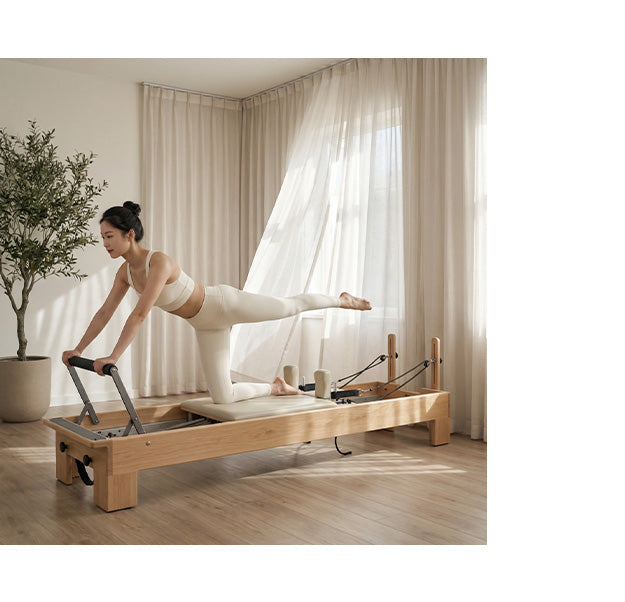
Traditional strength training builds prime movers through heavy lifting, whereas Pilates trains your body to transfer force efficiently from your core to your extremities. Here is how targeted mat or reformer work translates directly to better race times:
-
Pelvic Stability and Single-Leg Control: Every running stride is essentially a single-leg hop. Pilates strengthens the deep transverse abdominis and gluteus medius, preventing Trendelenburg gait (hip drop)—a primary culprit behind IT band syndrome and runner's knee.
-
Thoracic Spine Rotation and Breathing Mechanics: Upper-body stiffness wastes energy and restricts oxygen intake. Pilates emphasizes three-dimensional ribcage expansion (lateral thoracic breathing) and spinal rotation, helping your arms swing freely and delaying respiratory fatigue.
-
Eccentric Hamstring and Calf Resilience: Decelerating your body weight upon foot strike requires immense eccentric strength. Controlled Pilates movements build tendon elasticity and muscle endurance without heavy joint compression.
6 Essential Pilates Exercises for Runners
You do not need a studio reformer to see measurable improvements. Perform this 20-minute mat sequence twice a week focusing on slow, deliberate tempo and breath control.
1. Single-Leg Bridge (Glute & Hamstring Activation)
Target: Gluteus maximus, hamstrings, pelvic stabilizers.
-
Lie flat on your back with knees bent, feet hip-width apart, and arms pressed firmly into the mat.
-
Exhale to peel your spine off the floor into a bridge, keeping your ribs knitted down.
-
Extend your right leg straight toward the ceiling without letting your right hip dip below your left.
-
Lower the extended leg to hover parallel to your left thigh, then lift it back up with control. Complete 8–10 reps per side.

2. Side-Lying Leg Kick Series (Lateral Hip Stability)
Target: Gluteus medius, tensor fasciae latae (TFL), obliques.
-
Lie on your side with your hips stacked vertically and your bottom waist slightly lifted off the mat (creating a "mouse house" space).
-
Bring your legs slightly forward to a 30-degree angle for balance.
-
Lift your top leg to hip height, sweep it forward with a flexed foot for two pulses, then sweep it behind your hip with a pointed toe.
-
Keep your torso completely still—all movement must come from the hip joint. Perform 10–12 reps per side.

3. Swimming (Posterior Chain Endurance)
Target: Erector spinae, glutes, upper back extensors.
-
Lie prone (face down) with arms extended overhead and legs straight behind you.
-
Draw your navel slightly away from the mat to protect your lower back, and hover your chest, arms, and legs a few inches off the floor.
-
Flutter opposite arm and leg in small, brisk movements while breathing steadily (inhale for 5 counts, exhale for 5 counts).
-
Continue for 30–45 seconds. This directly counters the forward-slouch posture that develops late in long runs.

4. Dead Bug with Contralateral Reach (Anti-Extension Core Control)
Target: Transverse abdominis, pelvic floor, hip flexors.
-
Lie on your back with knees bent at 90 degrees in tabletop position and arms reaching straight toward the ceiling.
-
Inhale to prepare; exhale as you slowly extend your right leg forward and reach your left arm overhead.
-
Stop lowering your limbs the exact moment you feel your lower back begin to arch off the mat.
-
Return to center and switch sides. Complete 10 controlled reps per side.
5. Mermaid Stretch with Thoracic Rotation (Ribcage & Hip Mobility)
Target: Quadratus lumborum (QL), obliques, intercostals, hip internal/external rotators.
-
Sit in a Z-sit position (right shin parallel to the front of the mat, left shin folded behind you).
-
Reach your left arm overhead and side-bend toward the right, breathing deeply into your left ribcage.
-
Rotate your torso toward the floor, placing both hands on the mat to stretch the mid-back, before unwinding back to center. Perform 5 slow breaths per side.
6. Plank Leg Pull Front (Ankle Mobility & Whole-Body Integration)
Target: Anterior core, calves, Achilles tendon, shoulder girdle.
-
Start in a strong high plank with wrists stacked directly under shoulders and heels pressing back.
-
Lift your right leg two inches off the mat without shifting your hips.
-
Rock your body slightly backward through your left heel (stretching the calf and Achilles), then shift forward over your wrists.
-
Lower the foot and switch sides for 8–10 alternating reps.
The video below demonstrates the details of Pilates movements and breathing coordination for runners' core and hip stability:
1:https://youtu.be/3e1nVmV8_PI?si=et8at2WYFnse8-W_
2:https://youtu.be/j288GnrR7V4?si=PhxFZmkSI8GKJYmk
3:https://youtu.be/gfR1SsVxbz0?si=p2b1V3_gmI5gdz47

How to Schedule Pilates Around Your Running Plan
Timing matters. Because Pilates fatigues deep stabilizing muscles, doing an intense core session immediately before a speed workout or long run can compromise your running mechanics.
| Weekly Training Day | Primary Focus | Recommended Pilates Integration | Duration & Intensity |
| Monday | Rest or Active Recovery | Restorative mat mobility & breathing work | 15–20 mins (Low) |
| Tuesday | Speed / Interval Run | Skip Pilates or do 5-min pre-run glute activation | 5 mins (Warm-up only) |
| Wednesday | Easy Aerobic Run | Full Pilates Mat Strength Routine (post-run) | 25–30 mins (Moderate) |
| Thursday | Tempo / Threshold Run | Rest from cross-training | N/A |
| Friday | Easy Shakeout or Rest | Full Pilates Mat or Reformer Session | 30 mins (Moderate) |
| Saturday | Long Run | Post-run gentle spinal & hip flexor release | 10–15 mins (Low) |
| Sunday | Cross-Training / Recovery | Light foam rolling + Mermaid stretches | 15 mins (Low) |
Common Mistakes Runners Make When Starting Pilates
-
Rushing Through Reps: Runners are conditioned to chase pace and volume. In Pilates, speed uses momentum instead of deep muscle fibers. Slow down each transition by 50%.
-
Holding Your Breath: Gripping your abs while holding your breath locks up your diaphragm. Match every exertion phase with a full, audible exhale to engage the deep pelvic floor and transverse abdominis.
-
Ignoring Neutral Spine: Tucking your pelvis aggressively flattens your natural lumbar curve. Aim for a neutral pelvis where your hip bones and pubic bone rest on the same horizontal plane.
Frequently Asked Questions (FAQ)
How often should runners do Pilates?
Two sessions of 20 to 30 minutes per week is the sweet spot for most recreational and competitive runners. Consistency matters far more than session length—two short weekly sessions yield noticeable improvements in posture and hip stability within 4 to 6 weeks.
Should I do Pilates before or after a run?
Do full Pilates workouts after easy runs or on dedicated cross-training days. Pre-run Pilates should be limited to 5–10 minutes of light glute bridges and hip mobility drills so you do not fatigue your core stabilizers before hitting the road.
Can Pilates replace traditional heavy strength training for runners?
Pilates and heavy lifting serve different purposes. Pilates excels at neuromuscular control, joint stability, and spinal mobility, while heavy resistance training builds maximal bone density and tendon stiffness. For optimal performance, pair two short Pilates sessions with one or two heavy lower-body strength sessions each week.