


For Pilates brands, packaging is more than a way to protect products. It affects shipping efficiency, shelf presentation, brand recognition, and the customer’s first impression.
For B2B buyers, packaging decisions also influence production costs and order preparation. A box that looks good in a product photo may be too large for economical shipping. A custom printed package may suit a retail launch but create unnecessary costs for a small test order.
Before production begins, buyers should consider the product itself, the target market, the sales channel, and the expected order volume. Making these decisions early helps reduce avoidable changes and delays.

1. Choose Packaging Based on the Product
Different Pilates products have different packaging requirements. The best solution depends on product shape, material, weight, and how the item will be sold.
-
Pilates rings: Consider a protective bag, fitted carton, or retail box that accommodates the ring’s shape without putting unnecessary pressure on the handles.
-
Silicone dumbbells and wrist weights: Choose packaging that prevents products from rubbing against each other during transit. For heavier items, check whether the inner packaging and outer carton can support the load.
-
Pilates balls and resistance bands: Lightweight packaging may be sufficient, but the design should keep the contents organized and presentable.
-
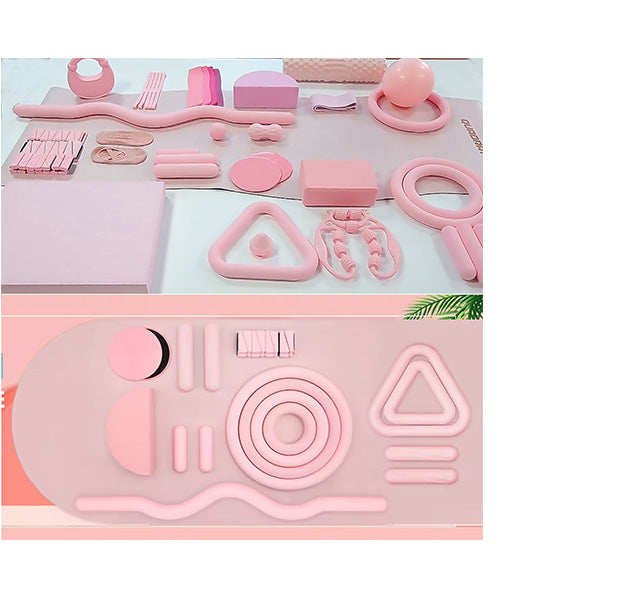
Pilates accessory sets: Use a box or insert that keeps each component in place. This is particularly useful when a set contains a ring, ball, resistance band, dumbbells, and wrist weights.
For mixed-product sets, confirm the dimensions of every item before finalizing the packaging. Product samples should be placed inside the proposed package to check fit, closure, and protection.
2. Decide Between Standard and Custom Packaging
Not every order needs fully customized packaging. The right choice depends on your brand stage, order quantity, and sales strategy.
Standard packaging is often suitable for market testing, smaller orders, and buyers who want to keep initial costs under control. Labels or stickers can provide basic brand identification without requiring a fully printed box.
Custom packaging is worth considering when consistent brand presentation is important across retail stores, e-commerce listings, or multiple product lines. Options may include printed boxes, custom inserts, branded product cards, and coordinated color schemes.
Before choosing, ask your supplier:
-
What standard packaging options are available?
-
Is there a minimum order quantity for custom printing?
-
Can different products share the same packaging design?
-
Will packaging samples be available before mass production?
-
Are setup, printing, and tooling costs charged separately?
Request a complete quotation rather than comparing only the unit price of the packaging. A low quoted price may exclude printing plates, inserts, labels, or other additional costs.
3. Keep Brand Design Consistent and Practical
Packaging should communicate your brand clearly without making the product harder to sell or more expensive to ship.
For private label Pilates products, prepare the following before artwork approval:
-
Brand logo and approved colors
-
Product name and accurate specifications
-
Product images or illustrations, if needed
-
Barcode or SKU information, where applicable
-
Care instructions and relevant warnings
-
Importer, manufacturer, or other required information for the destination market
Requirements vary by product and market, so confirm applicable labeling rules before printing. Do not assume that one packaging design will meet every country's requirements.
Keep the design readable at actual package size. Too much text, multiple competing colors, or oversized graphics can make packaging look cluttered.
For brands selling several Pilates accessories, a shared design system can help products look like part of one collection while allowing individual items to remain easy to identify.
4. Consider Shipping and Storage Before Finalizing the Box
Packaging affects more than appearance. It also determines how efficiently products can be packed, stored, and transported.
A box that is unnecessarily large may increase dimensional shipping charges, depending on the carrier and service. Excessively heavy packaging can also add to total shipment weight.
Ask your supplier to confirm:
-
Finished package dimensions and gross weight
-
Number of retail units per export carton
-
Export carton dimensions and gross weight
-
Carton stacking and storage requirements
-
Whether the packaging protects the product during normal handling and transit
For products with rigid frames, weighted components, or delicate finishes, evaluate the packaging using representative samples. Check for movement, surface scratches, crushed corners, and damage after suitable handling or transit tests.
Avoid removing protective materials simply to reduce package size before verifying that the product remains adequately protected.
5. Calculate the Full Packaging Cost
Packaging costs can be easy to underestimate when buyers focus only on the price per box.
A more useful calculation includes the main cost components:
| Cost item | What to confirm |
|---|---|
| Packaging material | Box, bag, sleeve, or protective materials |
| Printing | Logo, artwork, colors, and printing method |
| Inserts | Trays, dividers, or fitted supports |
| Setup costs | Printing plates, tooling, or design preparation, if applicable |
| Packing labor | Whether assembly and packing are included |
| Shipping impact | Added weight, carton size, and freight implications |
For example, a custom box may have a higher unit price than a standard box but offer a stronger retail presentation. Whether the extra cost makes sense depends on your selling price, order quantity, and target customer.
When comparing suppliers, request quotations based on the same packaging specifications and order quantity. This makes the comparison more meaningful and helps reveal costs that might otherwise be overlooked.
6. Confirm Samples and Specifications Before Mass Production
One of the most avoidable packaging problems is approving a design without checking the actual finished package.
Before production, confirm these details in writing:
-
Final artwork, logo placement, and colors
-
Package dimensions and material specifications
-
Product fit and protective inserts
-
Printing quality and finish
-
Barcode placement and label accuracy
-
Packing method and export carton configuration
-
Approved sample and any agreed quality standards
For customized orders, request a physical packaging sample or a representative pre-production sample when practical. A digital mockup can show the design, but it cannot fully confirm material strength, fit, or the finished appearance.
Also clarify who is responsible for approving the final artwork and what happens if packaging specifications change after approval. Changes made late in production can affect costs and delivery schedules.
7. Match Packaging to Your Sales Channel
The same Pilates product may need different packaging depending on where it will be sold.
Retail stores: Prioritize shelf presentation, clear product identification, and packaging that is easy to handle.
E-commerce: Consider protection against repeated handling, movement inside the parcel, and the combined dimensions of the retail package and shipping carton.
Fitness studios and wholesale distribution: Simple, durable packaging may be more practical when products are purchased in bulk or used as studio equipment.
Private label launches: A consistent visual identity, clear product information, and a manageable packaging budget can help brands launch new products without committing to unnecessary complexity.
Choose packaging for the actual sales channel rather than assuming that the most elaborate option is always the best.
A Practical Checklist Before You Place Your Order
Before approving Pilates product packaging, make sure you can answer the following questions:
-
Does the packaging fit and protect the product?
-
Is standard or custom packaging more suitable for this order?
-
Have minimum order quantities and additional printing costs been confirmed?
-
Are package dimensions and weights available?
-
Have the labeling requirements for the destination market been checked?
-
Has the final artwork been approved?
-
Has a sample been checked before mass production?
-
Are packing methods, export cartons, and delivery responsibilities clear?
Getting these details confirmed early makes it easier to manage costs, avoid last-minute changes, and prepare products for the intended market.
Work With a Supplier Who Understands Your Packaging Needs
For Pilates brands, packaging decisions should be made alongside product selection, branding, and shipping plans—not treated as a final step after production.
At MOWIN, we support wholesale and customized yoga and Pilates product projects. If you are developing a private label collection or building a retail-ready Pilates accessory set, discuss your product specifications, branding requirements, packaging preferences, and target order quantity with our team before production.
Planning a new Pilates product line? Contact MOWIN to discuss your product and custom packaging requirements.