


When launching a private-label fitness brand, outfitting a boutique yoga studio, or designing corporate wellness gifts, your custom yoga mat is a physical extension of your brand identity. But once you’ve selected your eco-friendly materials—whether it’s natural rubber, high-performance PU, or sustainable cork—you face a critical design decision: How should you apply your logo?
Choosing the wrong customization technique can lead to fading, peeling, or a cheap finish that detracts from your brand’s perceived value. To help you make the right choice, we’re breaking down the three industry-standard logo techniques: Silk Screen Printing, Debossing, and Laser Engraving.
1. Silk Screen Printing: The Vibrant, Classic Choice
Silk screen printing (or screen printing) is the most traditional and widely used method for customizing yoga mats. It involves pressing specialized, durable inks through a mesh stencil directly onto the surface of the mat.
-
How It Works: A stencil (screen) is created for your logo. Ink is then squeegeed across the screen, transferring the exact design onto the mat's surface.
-
Best Mat Materials: TPE, smooth Natural Rubber, and PU (Polyurethane).
-
Pros:
-
Pantone Color Matching: Perfect if your brand guidelines require exact color accuracy (e.g., matching a specific hex or Pantone code).
-
Cost-Effective for Bulk: Highly efficient and economical for large-scale production runs.
-
High Contrast: Delivers sharp, eye-catching graphics that pop against the mat's background color.
-
-
Cons:
-
Wear and Tear: Because the ink sits on top of the surface, high-friction areas (like where hands and feet repeatedly grip) may experience gradual fading or chipping over years of heavy use.
-
Texture Limitations: Extremely textured mats (like open-cell rubber with deep patterns) can cause ink bleeding.

-
2. Debossing: The Subtle, Tactile Luxury
Debossing uses a custom metal die, heat, and heavy pressure to stamp your logo directly into the material, creating a recessed, indented impression. (Its counterpart, embossing, raises the logo, though debossing is far more common and durable for yoga mats).
-
How It Works: A heated metal mold presses into the mat under high pressure, permanently compressing the material to form a clean, indented logo.
-
Best Mat Materials: Natural Cork, thick PU layers, and high-density Rubber.
-
Pros:
-
Permanent & Indestructible: Because no ink or thread is used, the logo cannot peel, flake, or fade. It lasts the entire lifespan of the mat.
-
Premium Tactile Feel: Gives the mat an upscale, minimalist aesthetic. Users can physically feel the texture of the brand.
-
Sweat-Resistant: Unlike ink, sweat and moisture will not degrade a debossed impression.
-
-
Cons:
-
No Color Options: The logo is monochromatic, taking on the exact color of the compressed substrate. It relies entirely on shadow and depth for visibility.
-
Material Restrictions: Does not work well on thin mats or materials that lack structural memory (such as cheap PVC or very soft TPE).

-
3. Laser Engraving: The Ultra-Precise Modern Method
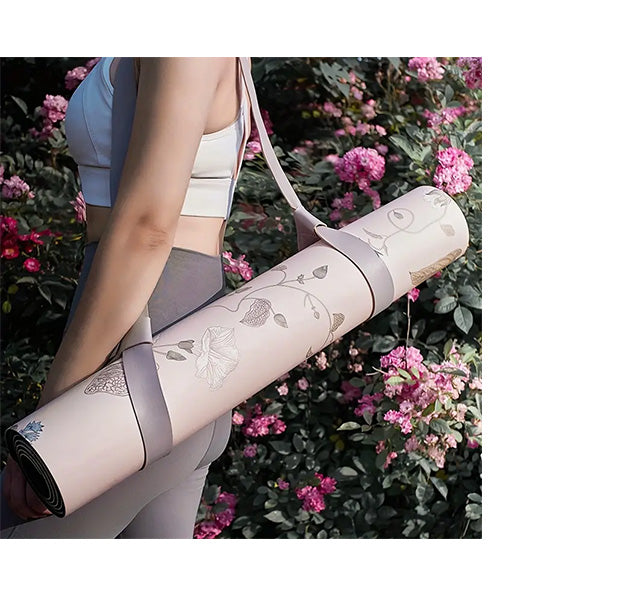
Laser engraving uses a focused beam of light to vaporize or etch the top layer of the yoga mat material, revealing a contrasting underlying layer or creating a sharp, precise burn mark.
-
How It Works: A computer-controlled laser burns away microscopic layers of the mat material according to your vector graphic file.
-
Best Mat Materials: Eco-friendly Cork, dual-layer TPE, and specific PU-coated rubber mats.
-
Pros:
-
Extreme Precision: Capable of rendering hyper-detailed artwork, intricate geometric patterns, and fine typography that screen printing or debossing cannot achieve.
-
Clean Edge Definition: Delivers razor-sharp edges and consistent depth across every single unit.
-
Eco-Friendly Process: Requires zero chemical inks, solvents, or physical molds.
-
-
Cons:
-
Color Limitations: Similar to debossing, the color is determined by the material underneath the top layer (often resulting in a darker, charred contrast or a lighter core).
-
Odor Warning: Immediately after production, some laser-engraved materials may carry a faint burnt scent, though this dissipates quickly with airing out.

-
Quick Comparison Table
| Feature | Silk Screen Printing | Debossing | Laser Engraving |
| Aesthetic Vibe | Bold, colorful, branded | Subtle, tactile, luxurious | Modern, sharp, intricate |
| Durability | Moderate (can wear over time) | Permanent (won't peel or fade) | Permanent (etched into material) |
| Color Capability | Full Pantone color matching | Monochromatic (same as mat) | Monochromatic (contrast burn/layer) |
| Best Suited Materials | TPE, Smooth Rubber, PU | Cork, Thick PU, Rubber | Cork, Dual-Layer TPE, PU |
| Ideal For | Fitness studios needing bold logos | Eco-conscious brands, minimalist design | Detailed artwork, complex typography |
How to Choose the Right Technique for Your Brand
To finalize your custom yoga mat design, ask yourself these three strategic questions:
-
What is your brand aesthetic? If your brand relies on vibrant, colorful logos that demand exact color-matching, Silk Screen Printing is your best bet. If you lean toward understated luxury, wellness, and minimalism, choose Debossing or Laser Engraving.
-
What material are you using? If you are designing cork yoga mats, debossing and laser engraving look stunning against the natural grain. If you are manufacturing high-performance PU rubber mats, silk screening or precise laser etching will highlight your brand best.
-
Who is your end user? For high-traffic commercial yoga studios where mats face harsh daily cleaning and heavy friction, permanent methods like debossing or laser engraving offer superior long-term ROI.
Ready to Bring Your Custom Yoga Mat to Life?
At MOWIN, we specialize in turning custom fitness visions into premium physical products. Whether you need vibrant color printing or precise laser-etched branding, our manufacturing experts are here to guide you through material selection and prototyping.