

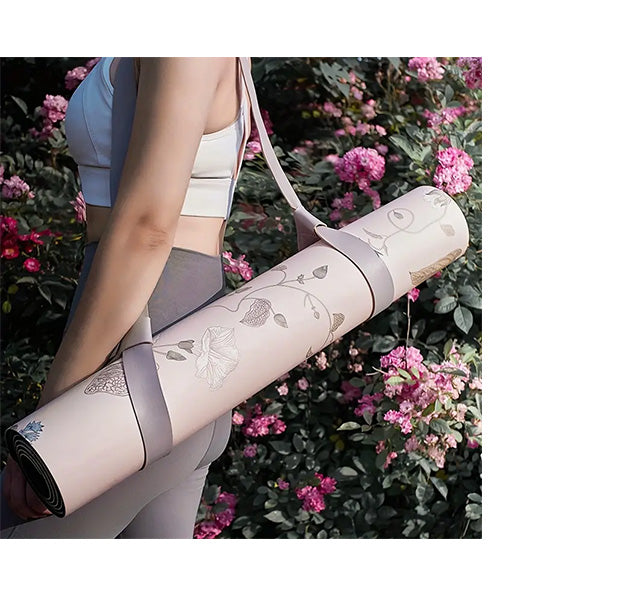

The size of your yoga mat directly impacts your comfort and stability during practice. A mat that's too small will make you practice cautiously, worrying about your hands and feet slipping off the edges. One that's too large not only takes up excessive space but is also inconvenient to carry and store.
The right length allows you to stretch out completely in supine or prone postures, while the appropriate width ensures you have enough space to maintain balance during various asanas. Thickness relates to the balance between joint protection and ground feel – too thin may not adequately protect your joints, while too thick can compromise pose stability.
Detailed Size Breakdown
Length Selection
Most standard yoga mats range from 170-185 centimeters in length. When selecting, ensure the mat length is at least equal to your height, preferably 10-15 centimeters longer than your height, allowing your entire body to lie fully on the mat during supine or prone postures.
For taller practitioners (over 180 cm), mats that are 185 cm or longer are recommended to ensure sufficient space for movement.
Width Selection
The standard yoga mat width is typically 61 centimeters (about 24 inches), which is sufficient for most practitioners.
If you need more spacious room or have a larger build, consider mats that are 68 centimeters or wider. These extra-wide designs offer greater freedom during practice without the worry of hands or feet sliding off the edge.
Thickness Selection
Thickness is a crucial factor affecting comfort and stability, with different thicknesses suiting different practice needs and usage scenarios:
| Thickness Range | Best For | Ideal Users |
| 1.5-3mm | Travel mats, extremely lightweight | Experienced practitioners, frequent travelers |
| 4-5mm | Versatile use, balances cushioning & stability | Most practitioners |
| 6-8mm | Extra cushioning, joint protection | Beginners, those with sensitive joints |
| 10mm+ | Maximum cushioning | Individuals with very sensitive joints or needing extra padding |
Beginners are generally recommended to use mats around 5mm to 6mm thick, providing adequate cushioning for the spine, hips, knees, and elbows. More experienced practitioners might prefer mats ranging from 3mm to 5mm thick, as they offer better ground feedback and stability.
Choosing Size Based on Personal Needs
By Height
When selecting a yoga mat, the length shouldn't be shorter than your height, and the width shouldn't be narrower than your shoulder width. A simple test method is: stand on the mat and check if your feet are completely within its boundaries; lie down and see if your body remains fully on the mat.
By Yoga Style
- Yin Yoga, Restorative Yoga: Choose thicker mats (5-8 mm) for better joint protection.
- Vinyasa, Ashtanga, Hot Yoga: Choose thinner mats (1-5 mm) for better stability and grounding.
By Usage Scenario
- Home Use: Can choose thicker, larger mats without worrying much about portability.
- Studio or Gym Use: Consider weight and portability; medium thickness is ideal.
- Travel: Choose lightweight, foldable, or easily rollable thin mats (1.5-3mm).
Material & Size Relationship
Different mat materials can result in varying weights and portability even at the same dimensions:
| Material | Characteristics | Impact on Size/Weight |
| PVC | Affordable, durable | Relatively heavy |
| TPE | Eco-friendly, lightweight, elastic | Lightweight |
| Natural Rubber | Excellent slip resistance, superior grip | Relatively heavy |
| Cork | Naturally antimicrobial, moisture-wicking, grippy | Moderate weight |
| PU | Good slip resistance | Often combined with a rubber base |
For instance, Manduka's natural rubber mat can weigh up to 3.18kg, while some TPE mats weigh only about 1kg, making them more suitable for carrying.
Popular Yoga Mat Size Comparison
| Product Name |
Length |
Width | Thickness | Material | Weight |
| Barefoot Yoga Performance Grip Mat | 72" (183cm) | 24" (61cm) | 4mm | Not Specified | 5 lbs (2.27kg) |
| Retrospec Solana Yoga Mat | 72" (183cm) | 24" (61cm) | 1/2" (12.7mm) | Foam | 1.07kg |
| Wild Blue Yonder Yoga Mat | 72" (183cm) | 27" (68cm) | 5mm | Suede Polyester Top, Natural Rubber Base | Not Specified |
| Clesign Eco Cork Yoga Mat | 185cm | 68cm | 5mm | Cork + Natural Rubber | 2.8kg |
| USHaS Horizon PU Yoga Mat | 185cm | 68cm | 4mm | PU + Natural Rubber | 2.81kg |
| BalanceFrom GoYoga Mat | 68" (173cm) | 24" (61cm) | 1/4" (6mm) | Foam | 680g |
Practical Selection Tips
1. Consider Storage Space: Measure the space where you plan to store your mat. Most mats can be rolled up, but thicker mats may take up more space when rolled.
2. Note the Weight: If you frequently carry your mat outdoors, weight is an important consideration. Lighter TPE or foam mats might be better, whereas natural rubber mats, while offering excellent grip, are typically heavier.
3. Check Slip Resistance: Besides size, slip resistance is crucial. Natural rubber and cork generally provide outstanding grip, especially suitable for practices like Vinyasa or Hot Yoga where you tend to sweat.
4. Consider Eco-Friendliness: If you value environmental sustainability, opt for mats made from TPE, natural rubber, or cork.
Summary: Golden Rules for Finding the Perfect Yoga Mat
1. Length: At least 10-15 cm longer than your height.
2. Width: Not narrower than your shoulder width, typically 61 cm or more.
3. Thickness: Choose based on experience level and yoga style.
4. Material: Balance slip resistance, durability, portability, and eco-friendliness.
The best yoga mat is a partner that supports your consistent practice. Taking the time to choose the right size is an investment your body and your yoga practice will thank you for. Remember, a yoga mat is an investment, not just a purchase—it's a vital tool on your wellness journey.
We hope this guide helps you find the ideal yoga mat size! When you're ready to choose a mat that fits your needs, feel welcome to explore MOWIN for a variety of yoga mats in different sizes and materials. Find the perfect partner that best supports your practice.
