



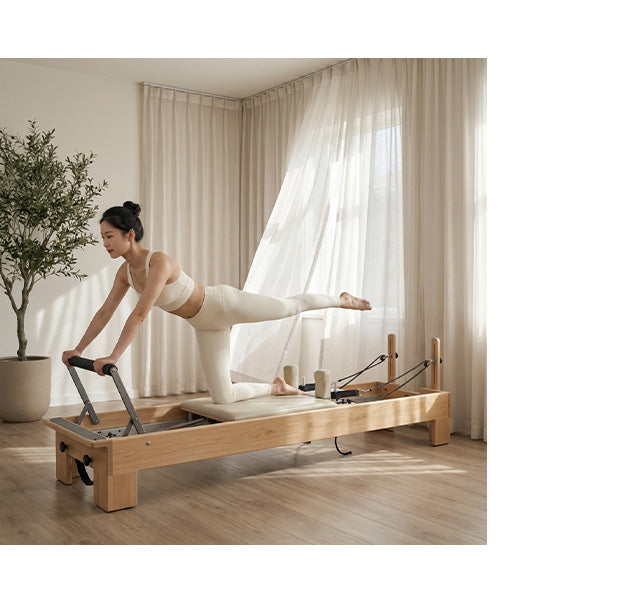

When fitness enthusiasts seek a balance between low-impact and high-efficiency exercises, Reformer Pilates is emerging as an "invisible fat-burning weapon" for urban populations. This training method, which combines strength, flexibility, and core control, not only enables practitioners to reshape their body lines through elegant movements but also achieves a calorie burn of 250-450 kcal per hour through its scientifically designed resistance system—a figure that even surpasses some traditional aerobic exercises. This article will delve into the fat-burning mechanisms of Reformer Pilates from three dimensions: energy metabolism, training variables, and long-term benefits.
In-Depth Analysis of the Weight-Loss Principles and Effects of Reformer Pilates
1. Weight-Loss Principles: Synergistic Effects of Three Mechanisms
The fat-loss effects of Reformer Pilates are not reliant on a single factor but are achieved through the synergistic effects of muscle activation, metabolic enhancement, and hormonal regulation:
-
Continuous Muscle Work: Breaking the Energy Balance
The core design of the Reformer—the spring resistance system—requires practitioners to continuously resist tension during each movement. For example, in the "Single Leg Stretch" exercise, the quadriceps of the thighs, the gluteus maximus of the buttocks, and the core muscles must all work together to control the movement of the carriage. This multi-muscle collaborative work mode significantly increases energy consumption per unit of time. Studies show that compared to traditional mat Pilates, muscle electrical activity (EMG) intensity during Reformer training increases by 40%, meaning more calories are converted into mechanical energy. -
Unstable Surface Training: Activating Deep Stabilizing Muscles
The carriage design of the Reformer creates a dynamic unstable environment, forcing the body to recruit deep stabilizing muscles (such as the transverse abdominis and multifidus) to maintain balance. Although these muscles are small in size, their energy consumption per unit of time is three times that of superficial muscles. For instance, in the "Balanced Standing" exercise, to prevent the carriage from sliding sideways, the gastrocnemius muscles of the calves and the plantar fascia must continuously adjust tension. This "hidden exertion" can consume an additional 15-20% of calories. -
The Perfect Combination of Low-Impact Aerobic and Resistance Training
Reformer classes typically include dynamic flowing movements (such as completing 50 repetitions of "The Hundred" continuously) and static holding movements (such as holding a "Plank" for 30 seconds). This combination not only elevates the heart rate through aerobic rhythm (entering the fat-burning zone) but also increases muscle mass through resistance training—and for every 1 kg of muscle gained, the body's basal metabolic rate (BMR) increases by 50 kcal per day.
2. Weight-Loss Effects: Double Verification through Data and Cases
-
Short-Term Effects: Visualizing Calorie Consumption
According to a 2022 study in the Journal of Sports Medicine, an average 60-minute Reformer class (including flowing movements) burns the following calories:- Basic Level: 250 kcal (2 springs + slow control)
- Intermediate Level: 350 kcal (3 springs + moderate pace)
- High-Intensity Level: 450 kcal (4 springs + dynamic jumping)
Comparison with other exercises:
Exercise Type Calories Burned per Hour Characteristics Reformer Pilates 250-450 kcal Low-impact, sustained fat burning Jogging (8 km/h) 600-800 kcal High-impact, prone to joint injuries Yoga (Vinyasa) 180-300 kcal Focus on flexibility, lower fat-burning efficiency -
Long-Term Effects: Bidirectional Regulation of Body Fat Percentage and Muscle Mass
The American Council on Exercise (ACE) tracked 120 obese women (BMI ≥ 28) who underwent 12 weeks of Reformer training in 2021, with the following results:- Body Fat Percentage: An average decrease of 3.2% (compared to 0.8% in the control group)
- Waist Circumference: A reduction of 5.8 cm (compared to 1.2 cm in the control group)
- Muscle Mass: An increase of 1.5 kg (compared to a decrease of 0.3 kg in the control group)
Typical Case:
A 32-year-old office worker (initial weight: 68 kg, body fat percentage: 28%) adhered to three 50-minute Reformer sessions per week. Her progress was as follows:-
Week 4: Weight loss of 2 kg (1 kg of fat and 1 kg of water)
-
Week 8: Body fat percentage dropped to 24%, waist circumference reduced by 7 cm, and she could perform high-difficulty exercises like "Jumpboard Jumping"
-
Week 12: Weight stabilized at 63 kg, body fat percentage at 21%, with visible muscle definition and significantly improved daily energy levels
Scientific Data: Deconstructing the 250-450 kcal Calorie Burn per Hour
1. Quantitative Analysis of Metabolic Equivalents (METs)
According to a 2014 study in the Journal of Exercise Science, the metabolic equivalent (MET) value of moderate-intensity Reformer Pilates can reach 3.2-6.7. This means that a 68 kg practitioner can burn 150-250 kcal per hour. In more dynamic advanced classes, this value can soar to 7.5 METs, corresponding to a calorie burn of 450 kcal per hour. This difference stems from the dynamic adjustment of spring resistance—when practitioners perform exercises like "The Hundred" or "Footwork," their muscles must continuously resist spring tension, creating a metabolic stimulus similar to resistance training.
2. Intuitive Presentation through Comparative Experiments
A 2020 study in ScienceDirect showed:
- Reformer Group: An average calorie burn of 250 kcal per hour (basic movements) to 450 kcal per hour (high-intensity flowing training)
- Mat Group: An average calorie burn of 116-175 kcal per hour
- Running Group: An average calorie burn of 600-800 kcal per hour (speed: 8 km/h)
Although Reformer training burns fewer calories per unit of time than running, its unique advantage lies in the Excess Post-Exercise Oxygen Consumption (EPOC) effect caused by continuous muscle activation. Studies indicate that for 24 hours after Reformer training, the body still maintains an additional 10-15% calorie burn, an effect particularly significant during the muscle-building and body-shaping phase.
Five Variables: Determining Your Fat-Burning Efficiency
1. Spring Resistance System
The core design of the Reformer—the adjustable spring set—is key to controlling training intensity. Each spring provides approximately 4.5 kg of resistance, and by increasing or decreasing the number of springs (1-4) or changing the movement trajectory (e.g., switching from "Single Leg Stretch" to "Double Leg Jumping"), calorie consumption can vary by a factor of three. For example:
- Basic Version: 2 springs + slow control → 250 kcal/hour
- Advanced Version: 4 springs + dynamic flowing movements → 450 kcal/hour
2. Movement Combinations and Rhythm
Flowing classes reduce rest time between movements by串联 (linking) exercises, keeping the heart rate within 60-75% of the maximum heart rate (the fat-burning zone). For example:
- Traditional Class: Rest for 30 seconds after completing "Rolling Like a Ball" → A temporary drop in metabolic rate
- Flowing Class: Seamlessly transition from "Rolling Like a Ball" to "Single Leg Stretch" to "Side Kick" → Sustained fat burning
3. Body Mass Index (BMI)
Body weight directly affects calorie consumption. For a 60-minute class:
- 50 kg Practitioner: Approximately 200-300 kcal burned
- 70 kg Practitioner: Approximately 280-420 kcal burned
- 90 kg Practitioner: Approximately 360-540 kcal burned
4. Muscle Recruitment Pattern
Reformer training through unstable surface exercises (such as standing on the carriage to perform "Balanced Standing") forces deep stabilizing muscles (e.g., the multifidus and transverse abdominis) to work continuously. Although these muscles are small, their energy consumption per unit of time is three times that of superficial muscles, thereby increasing overall calorie burn.
5. Class Duration and Frequency
A 2016 tracking study in the Journal of Physical Therapy Science showed:
-
3 sessions per week, 45 minutes each: After 12 weeks, body fat percentage decreased by 2.3%, and muscle mass increased by 1.8%
-
5 sessions per week, 60 minutes each: Over the same period, body fat percentage decreased by 4.1%, and muscle mass increased by 3.2%
Beyond Fat Burning: The Long-Term Health Value of Reformer Pilates
1. Enhanced Metabolic Flexibility
Continuous practice can improve insulin sensitivity, enabling the body to utilize carbohydrates more efficiently. A 2019 Brazilian study confirmed that after 9 weeks of Reformer training, fasting blood glucose levels in subjects decreased by 12%, and triglyceride levels dropped by 18%—key indicators for preventing metabolic syndrome.
2. Injury Prevention
Compared to traditional aerobic exercises, Reformer's closed-chain movement patterns (e.g., keeping the feet fixed on the carriage during "Footwork") reduce joint impact forces by up to 70%. For runners or rehabilitation populations, incorporating Reformer as cross-training can significantly lower the risk of knee injuries.
3. Posture Remodeling Effects
By strengthening deep core muscles (such as the pelvic floor and transverse abdominis), Reformer training can fundamentally improve posture issues like rounded shoulders and anterior pelvic tilt. A 2021 case study in the British Journal of Sports Medicine showed that after 6 months of training, an office worker's waist circumference reduced by 7 cm, and the frequency of neck pain decreased by 85%.
Practical Guide: How to Maximize Fat-Burning Effects
1. Class Selection Strategies
- Beginners: Start with 45-minute basic classes, focusing on mastering breathing and movement control
- Intermediate Practitioners: Choose 60-minute flowing classes, increasing spring resistance and dynamic movements
- Advanced Practitioners: Try Jumpboard classes, incorporating vertical jumps to elevate heart rate
2. Nutritional Synergy Plan
- 1 hour before training: Consume 20 g of slow-release carbohydrates (e.g., oats) + 10 g of protein (e.g., whey protein)
- 30 minutes after training: Supplement with 30 g of rapidly absorbed protein (e.g., eggs) + 50 g of complex carbohydrates (e.g., sweet potatoes)
- Daily Hydration: Drink at least 2 liters of water, supplementing with 150 ml of electrolyte water every 15 minutes during training
3. Home Training Optimization
If unable to attend studio classes, simulate Reformer effects through the following methods:
-
Resistance Band Alternatives: Fix resistance bands to a doorframe to mimic "Rowing" movements
-
Slider Training: Use sliders on a wooden floor to perform "Double Leg Stretch"
-
Bodyweight Progressions: Add single-leg lifts to "Planks" to increase instability
Conclusion: An Elegant Dialogue with the Body
The charm of Reformer Pilates lies in its ability to break the fitness myth that "high intensity equals high injury risk." As you feel the subtle contractions of your muscles against spring tension and experience the flow of energy through elegant movements, this training transcends mere calorie burning to become a holistic practice of body-mind integration. Whether you're a fitness enthusiast pursuing a defined waistline or someone in need of rehabilitation training, you can find your own fat-burning rhythm on this seemingly simple apparatus—after all, the best exercise is always the one you can stick to for a lifetime.
 Image Source:https://tinyurl.com/3byu8wdh