



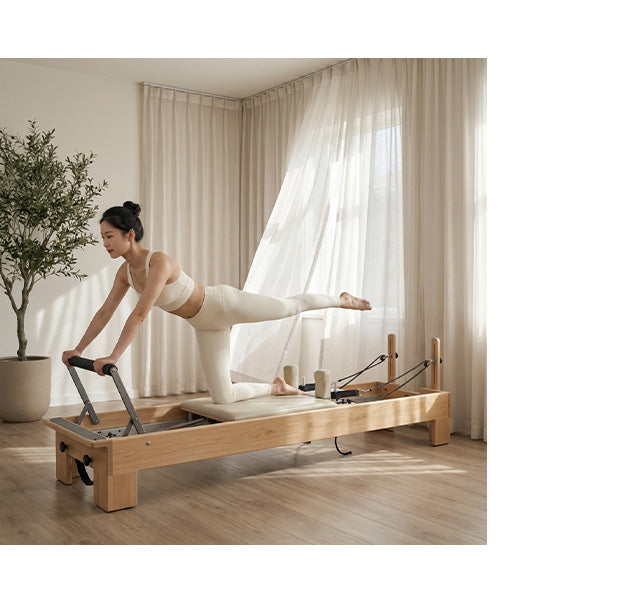

In the realm of fitness, "efficiency" remains the ultimate keyword. As the Pilates Reformer, with its sophisticated spring resistance system and dynamic control training, sweeps across the globe, traditional strength training enthusiasts still firmly believe that barbell squats and deadlifts are the ultimate weapons for muscle gain and fat loss. Behind this controversy lies the deep integration of modern fitness concepts with exercise science, biomechanics, and rehabilitation medicine. This article will conduct a comparative analysis from three key dimensions—muscle activation patterns, metabolic enhancement mechanisms, and joint stress distribution—to provide fitness enthusiasts with a scientific basis for decision-making.
1. Muscle Activation Patterns: Precision Control vs. Compound Explosiveness
Pilates Reformer: The Ultimate Training Ground for Neuromuscular Control
The Pilates Reformer creates a three-dimensional dynamic training environment through its spring resistance system (adjustable from 0.5 to 100 kg) and sliding track design. Its core advantages include:

- Prioritized Activation of Deep Muscles: Studies show that during the "footwork" exercise, the transverse abdominis activation intensity is 2.3 times higher than that of traditional crunches, with a 41% increase in pelvic floor muscle engagement. The progressive resistance of the springs forces the body to maintain a neutral spine position, compelling stabilizing muscles like the multifidus to contract continuously.
- Controlled Movement Trajectories: The linear motion of the sliding track limits compensatory movement paths, forcing practitioners to complete actions through coordinated core muscle engagement. For example, in the "Mermaid" exercise, lateral flexion requires simultaneous control of the obliques, latissimus dorsi, and gluteus medius, resulting in a 27% higher neuromuscular recruitment efficiency compared to free-weight training.
- Eccentric Contraction Emphasis: The resistance generated during the spring's return phase keeps muscles under tension while lengthening. This training mode has been proven to increase tendon stiffness by 15-20%, significantly enhancing athletic performance.
Traditional Strength Training: The Explosive Art of Major Muscle Group Synergy
Taking the barbell squat as an example, its muscle activation characteristics are as follows:
-
Compound Movement Advantages: A single squat simultaneously activates the quadriceps (with maximum contraction forces reaching 3.2 times body weight), gluteus maximus (2.8 times), and core muscles (1.5 times), with a metabolic equivalent (METs) of 8.5—far exceeding the 4.2 of Pilates Reformer training.

- Muscle Fiber Type Differentiation: Heavy-weight, low-repetition training (3-6RM) primarily stimulates hypertrophy of Type II muscle fibers, while the sustained tension training of the Pilates Reformer focuses more on Type I fiber endurance development.
- Neural Adaptation Differences: The motor cortex activation area in strength trainers is 18% larger than that in Pilates practitioners, with this neural plasticity change directly linked to improved force output capacity.
2. Metabolic Enhancement Mechanisms: Afterburn Effect vs. Basal Metabolic Revolution
Pilates Reformer: Precision-Regulated Sustained Fat Burning
- EPOC Effect: Moderate-intensity Pilates Reformer training (maintaining heart rate at 60-70% of maximum) can sustain excess post-exercise oxygen consumption (EPOC) for 24-36 hours, burning an additional 120-180 kcal during this period. The mechanism lies in the energy required for micro-damage repair of muscle fibers caused by spring resistance training.
- Hormonal Regulation: Regular training can reduce cortisol levels by 22% while increasing growth hormone secretion by 17%. This hormonal combination has been proven to optimize fat-breaking enzyme activity.
- Metabolic Flexibility: By improving mitochondrial function, Pilates Reformer training enhances fat oxidation utilization by 9% compared to traditional strength training, offering significant advantages during prolonged low-intensity exercise.
Traditional Strength Training: The Violent Ignition of the Metabolic Engine
- Immediate Energy Expenditure Burst: A 60-minute strength training session can burn 400-800 kcal (depending on load intensity), with compound exercises like deadlifts being 2.3 times more energy-efficient than Pilates Reformer training.
- Muscle Mass Dividend: Each additional kilogram of muscle increases resting metabolic rate by 13-15 kcal/day. After 12 weeks of systematic training, strength trainers can burn 200-300 kcal more per day at rest than Pilates practitioners.
- Metabolic Restructuring: High-intensity strength training significantly elevates skeletal muscle GLUT4 transporter protein expression, improving glucose uptake efficiency by 31%—a clinically significant improvement in insulin sensitivity.
3. Joint Stress Distribution: Rehabilitation Tool vs. Load Challenge
Pilates Reformer: The Precision Risk Avoidance of Biomechanics
- Three-Dimensional Shock Absorption System: Spring resistance provides progressive loading, reducing wrist joint pressure to just 38% of that in traditional push-ups during the "push-up" exercise—particularly beneficial for rehabilitation patients.
- Spine-Friendly Design: The sliding track system allows spinal movement within physiological curvature ranges, reducing lumbar pressure by 62% compared to traditional deadlifts—offering therapeutic value for patients with lumbar disc herniation.
- Dynamic Stability Training: Training on unstable surfaces (like the Pilates Reformer's footbar) increases joint-surrounding muscle activation by 40%. This training mode has been proven to reduce sports injury risk by 33%.
Traditional Strength Training: The Double-Edged Sword of Load Management
- Joint Compression Risks: During heavy squats, knee joints bear pressures reaching 5-7 times body weight. Incorrect movement patterns increase the incidence of patellofemoral pain syndrome by 2.1 times.
- Adaptive Strengthening: Systematic training can increase articular cartilage thickness by 12-15% and bone density by 8-10%. These structural changes require strict adherence to the progressive overload principle.
- Movement Economy Optimization: Experienced strength trainers can distribute joint pressure across multiple planes through neuromuscular coordination. For example, hip abduction during squats reduces knee valgus.
4. Scientific Training Recommendations: Integration Rather Than Opposition
- Muscle Gain Phase: Prioritize traditional strength training (3-4 sessions/week) while incorporating Pilates Reformer training (1-2 sessions/week) to enhance core stability and joint health.
- Fat Loss Phase: Adopt a circuit training model, alternating between the sustained tension training of the Pilates Reformer and the explosive movements of traditional strength training to maximize the EPOC effect.
- Rehabilitation Phase: Use the Pilates Reformer first for neuromuscular control reconstruction, gradually introducing light-load strength training to restore muscle volume.
- Anti-Aging Training: Combine the flexibility training of the Pilates Reformer with the bone density enhancement of traditional strength training to build a comprehensive protective system.
From the perspective of exercise science, training efficiency should not be simply equated with calorie burn or muscle growth per unit time but should encompass multidimensional indicators such as sports injury risk, long-term health benefits, and functional performance improvements. The comparison between the Pilates Reformer and traditional strength training is essentially a dialogue between precision control and explosive power, rehabilitation medicine and athletic performance, and neural adaptation and structural remodeling. True fitness wisdom lies in dynamically adjusting training tools according to individual needs, allowing the elastic tension of springs and the rigid load of barbells to jointly compose a symphony of health.