

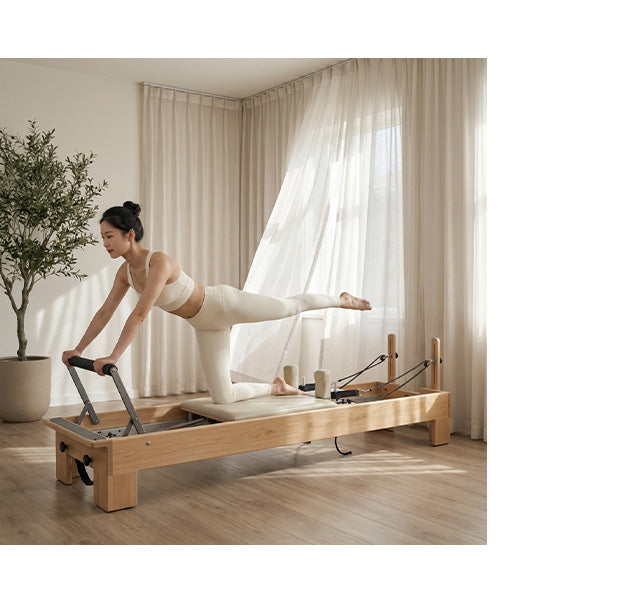

Among the "aristocrats" of fitness equipment, the Pilates Reformer stands out as a star choice for celebrity personal trainers and rehabilitation training, thanks to its unique design and versatility. This apparatus, composed of springs, a sliding carriage, ropes, and an adjustable platform, precisely activates deep muscles and enhances body control through dynamic balance training. This article will provide a comprehensive breakdown of a complete Reformer training routine, covering classic movements from warm-up to advanced levels, and explain how to adjust training intensity based on specific goals.

I. The Core Structure and Training Principles of the Reformer
The Reformer's core lies in its spring resistance system and sliding carriage. By adjusting the number of springs (typically 1-4) and rope length, you can freely switch between "assisted mode" and "challenge mode." For example:
- Fewer springs: Lower resistance, ideal for beginners or rehabilitation.
- More springs: Higher resistance, suitable for strength building.
- Unstable platform (e.g., removing the footbar): Activates deep core muscles through dynamic balance.
This design allows the Reformer to simultaneously meet three key needs: strength training, flexibility stretching, and balance control, making it especially beneficial for sedentary individuals, athletes, or postpartum recovery.
II. Classic Reformer Training Routine (60 Minutes)
1. Warm-Up Phase (10 Minutes): Awaken Body Awareness
Goal: Activate the core and establish spinal mobility
Sample Movements:
-
Footwork
- Lie supine with feet on the carriage and 2-3 springs set.
- Perform sequential movements: "toe points → knee bends to push carriage → straight-leg extensions," feeling the engagement in the hamstrings and glutes.
- Advanced: Alternate legs while maintaining pelvic stability.
-
The Hundred
- Lie supine with legs in "tabletop" position and hands gripping ropes.
- Inhale to lift the head, then pump arms up and down 100 times while synchronizing with breath rhythm.
- Key: Avoid neck strain by using the abdominals to "lift" the upper body.
2. Strength Building Phase (30 Minutes): Precision Muscle Sculpting
Goal: Full-body strength enhancement, focusing on the core, glutes, legs, and upper body
Sample Movements:
-
Long Stretch
- Assume a plank position with hands on the carriage and feet on the platform.
- Inhale to push the platform away while maintaining spinal neutrality; exhale to pull back, feeling the abdominal "zipper" contraction.
- Advanced: Lift one leg for added instability.
-
Frog
- Lie supine with legs bound by ropes in a "frog leg" position (externally rotated).
- Inhale to open legs to the limit; exhale to bring them inward to 45 degrees. Repeat 10 times.
- Key: Maintain posterior pelvic tilt to avoid lumbar compensation.
-
Chest Expansion
- Sit upright, gripping ropes behind you. Pull backward while opening the chest.
- Keep shoulder blades depressed and avoid shrugging. Repeat 12 times.
- Benefit: Improves rounded shoulders and strengthens back muscles.
3. Flexibility and Balance Phase (15 Minutes): Enhance Body Control
Goal: Stretch tight muscles and improve joint stability
Sample Movements:
-
Mermaid
- Sit sideways with one hand on the floor and the other gripping a rope.
- Inhale to side-bend and stretch; exhale to return. Repeat 8 times per side.
- Key: Maintain pelvic stability to avoid tilting.

-
Single Leg Circle
- Lie supine with one leg bound by a rope and the other bent at the knee.
- Inhale to draw a circle with the extended leg; exhale to reverse direction. Perform 10 reps per side.
- Benefit: Activates hip flexibility and addresses lower-body strength imbalances.
4. Cool-Down and Recovery Phase (5 Minutes): Integrate Training Effects
Goal: Lower heart rate and relieve muscle tension
Sample Movements:
-
Child’s Pose with Reformer
- Kneel with hips on heels and hands gripping ropes extended forward.
- Hold for 30 seconds to release back and shoulder tension
 Image Source:https://tinyurl.com/37uj495y
-
Deep Breathing
- Lie supine with knees bent and hands on the abdomen.
- Inhale to expand the abdomen; exhale to contract. Repeat 5 times.
III. How to Adjust Training Intensity Based on Goals?
1. Beginners: Safety First, Build Foundations
- Spring count: 2 (moderate resistance)
- Range of motion: Reduce (e.g., leg circles ≤45 degrees)
- Key: Prioritize movement quality over quantity to avoid compensation.
2. Advanced Users: Challenge Limits, Break Plateaus
- Spring count: 3-4 (high resistance)
- Movement combinations: Incorporate high-difficulty moves like "Scooter" or "Teaser."
- Key: Maintain core stability and control movement rhythm.
3. Rehabilitation Training: Precise Repair, Avoid Injury
- Spring count: 1 (low resistance)
- Movement selection: Focus on low-impact exercises like "Spine Stretch" or "Shoulder Bridge."
- Key: Train under a physiotherapist’s guidance and avoid overstretching.
IV. Common Mistakes and Corrections in Reformer Training
-
Mistake: Neck strain (e.g., lifting head too high in The Hundred)
Correction: Use abdominals to "lift" the upper body; tuck the chin slightly. -
Mistake: Locking joints (e.g., hyperextending elbows in Long Stretch)
Correction: Keep joints slightly bent and control movements with muscles. -
Mistake: Ignoring breath (e.g., holding breath during exertion)
Correction: Follow "inhale to prepare, exhale to exert" principle.
V. Long-Term Benefits of Reformer Training
- Posture improvement: Corrects rounded shoulders, anterior pelvic tilt, and other common issues.
- Pain relief: Reduces lumbar pressure by strengthening the core.
- Enhanced athletic performance: Improves coordination and reduces injury risk.
- Mental relaxation: Combines breathwork to alleviate anxiety.
Conclusion
The Reformer is more than just equipment—it’s a "body reshaping system." Through scientifically arranged movement sequences, you’ll feel muscles awaken with every push and pull, and rebuild the connection between body and mind with every breath. Whether you’re chasing abs, seeking back pain relief, or aiming to elevate athletic performance, the Reformer can be your ultimate training partner. Now, step onto your carriage and embark on this transformative journey of body and mind!